

Similiar games












The Choicer Voicer
Listen, Perform, and Let the Judges Decide
The Choicer Voicer is a voice-impression game that turns your microphone into the main controller. Each challenge begins with an audio sample, but simply remembering the words isn’t enough. You need to listen to how the original voice actually sounds and then attempt to reproduce its pitch, rhythm, speed, pauses, and overall delivery. A short phrase that appears incredibly easy while you’re listening can become surprisingly difficult the moment it’s your turn to perform it. Strange character voices, rapid speech, dramatic shouting, awkward pauses, and sudden changes in pitch force you to do much more than repeat a sentence in your normal voice.
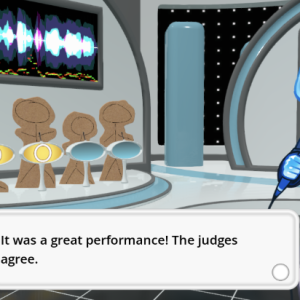
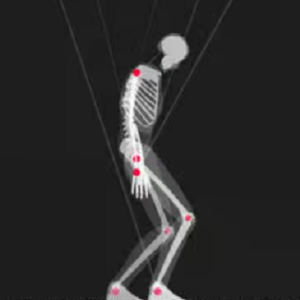
Everything is presented as a game show rather than a basic microphone test. Contestants take the stage, performances are presented to a judging panel, and the entire setup turns a simple voice imitation into a competition. This presentation is particularly effective when several people are playing together because everyone gets to hear both sides of the challenge: first the original sample and then whatever the current player manages to produce. Sometimes the result is impressively close. Sometimes it sounds nothing like the reference. Both outcomes are part of what makes The Choicer Voicer entertaining.
The game becomes even more unusual once you start exploring its custom content. Voice Packs determine which samples appear, while additional content can change contestants, judges, studios, and other parts of the presentation. Dub Packs take the concept further by allowing players to record dialogue for complete scenes. Instead of offering one fixed collection of challenges, The Choicer Voicer provides a structure that can continually change depending on which content you decide to use.
A Simple Idea That Becomes Surprisingly Difficult
The basic objective can be explained in seconds: hear a voice and imitate it. The difficulty comes from realizing how many small details make one voice different from another.
Imagine hearing a character say a five-word sentence. Remembering those five words isn’t difficult. But perhaps the character begins quietly, suddenly raises their voice on the third word, pauses before the final phrase, and finishes with an exaggerated accent. If you repeat only the text, you’ve reproduced the sentence but not the performance.
That’s where the actual challenge begins.
Players need to concentrate on the characteristics of the reference audio rather than treating it like a memory test. Listen for pitch first. Is the speaker considerably higher or lower than your natural voice? Then focus on speed. Some clips are difficult because the words arrive quickly, while others use unusually slow or broken delivery. Emotion matters as well. Anger, excitement, panic, boredom, sarcasm, or an intentionally ridiculous performance can define the entire sample.
The best attempts come from identifying these characteristics quickly and then committing to them when the microphone starts recording.
The Anatomy of a Voice Challenge
| Element | What to Listen For | Why It Matters |
|---|---|---|
| Pitch | High, low, changing or stable voice | Defines the basic sound of the impression |
| Speed | Slow speech or rapid delivery | Changes how difficult the line is to reproduce |
| Rhythm | Pauses and emphasized words | Helps capture the original delivery |
| Volume | Whispering, normal speech or shouting | Can completely change the performance |
| Emotion | Anger, fear, excitement, boredom | Makes the imitation recognizable |
| Accent/Style | Unusual pronunciation or character voice | Often becomes the hardest detail to copy |
| Timing | Length of words and pauses | Keeps your version closer to the reference |
You don’t necessarily need to reproduce every characteristic perfectly. When a clip is particularly difficult, concentrate on whichever feature makes it instantly recognizable. An extremely deep character voice is probably defined more by pitch than by perfect pronunciation. A frantic character speaking at incredible speed may require rhythm and pacing before anything else.
This makes every Voice Pack feel slightly different. A pack filled with normal dialogue tests different skills from one built around exaggerated fictional characters.
Voice Packs Provide the Challenges
Voice Packs are fundamental to The Choicer Voicer because they contain the audio material players are asked to perform. Changing the active Voice Packs effectively changes the pool of challenges available during gameplay.
This creates much more variety than a traditional game with a permanent list of levels. A Voice Pack can concentrate on one character, several related characters, a particular series, funny clips, memes, unusual noises, difficult impressions, or practically any other theme suitable for voice imitation.
A simple pack can provide quick challenges that anyone can attempt immediately. A more demanding collection can deliberately use voices that are difficult to reproduce. Players who become comfortable with ordinary dialogue can therefore move toward packs containing faster speech, wider pitch changes, or more exaggerated performances.
Custom Voice Packs also make The Choicer Voicer especially suitable for groups. If everyone playing recognizes a particular set of characters or jokes, a themed pack immediately becomes more entertaining because players understand exactly what they’re trying to imitate.
Why Some Voice Packs Are Much Harder Than Others
Two packs containing the same number of samples can have completely different difficulty levels.
| Voice Pack Style | Typical Challenge | Approximate Difficulty |
|---|---|---|
| Normal Dialogue | Natural speaking voices | ●●○○○ |
| Character Quotes | Distinctive voices and delivery | ●●●○○ |
| Fast Speech | Keeping pace with the sample | ●●●●○ |
| Extreme Voices | Very high or low pitch | ●●●●○ |
| Mixed Challenge Pack | Constantly changing vocal styles | ●●●●● |
The difficulty scale above is illustrative rather than an official in-game rating.
A pack becomes particularly challenging when individual clips require several skills simultaneously. A high-pitched sentence isn’t necessarily difficult if it’s spoken slowly. A fast sentence isn’t always difficult if the voice is close to your natural speaking range. Combine extreme pitch, fast delivery, unusual pronunciation, and strong emotion, however, and suddenly even a short phrase becomes a serious challenge.
This is why simply adding new Voice Packs can significantly change the experience without modifying the game’s fundamental mechanics.
The Game-Show Presentation Makes Failure Entertaining
The Choicer Voicer doesn’t treat your performance like a recording exercise. The game wraps everything inside a show with contestants and judges, making each attempt feel like a small performance rather than a technical audio test.
That distinction matters because failure becomes part of the entertainment.
In many games, performing badly means losing progress and repeating something you already understand. Here, a terrible impression can be more memorable than a good one. If someone attempts a dramatic character voice and produces something completely different, everyone immediately hears the result. The judging presentation then provides the conclusion to the performance.
This structure is especially effective in local multiplayer. Other players hear the same reference clip, which means everyone already has an idea of what the performance should sound like. They can immediately tell when the current player has captured the voice—or completely destroyed it.
The result is competition without requiring complicated rules. Everyone understands the challenge because everyone heard the same sound.
Different Players Have Different Vocal Advantages
Not everyone finds the same samples difficult.
A player with a naturally deep voice may reproduce low-pitched characters easily but struggle with extremely high voices. Someone who can rapidly change pitch might perform cartoon characters surprisingly well but have difficulty reproducing subtle accents. Another player may be excellent at remembering rhythm even when the actual voice sounds completely wrong.
This creates natural variety between players.
| Player Strength | Usually Helps With |
|---|---|
| Wide vocal range | Extreme character voices |
| Good rhythm | Fast or unusually paced dialogue |
| Strong memory | Longer samples |
| Accent imitation | Character-specific pronunciation |
| Volume control | Whispering and shouting |
| Acting ability | Emotional performances |
There’s no single skill that guarantees success with every pack. Changing the content can completely rearrange which player has an advantage.
That makes a mixed collection particularly useful for multiplayer. Instead of allowing one person to dominate every round using the same skill, different clips can favor completely different types of performers.
Custom Contestants Change Who Takes the Stage
Voice samples provide the challenge, but The Choicer Voicer’s customization extends beyond audio. Contestant Packs allow different characters to represent players during the show.
This gives themed setups much more personality. If you’re using Voice Packs based around a particular type of content, you can combine them with contestants that fit the same theme. Alternatively, you can deliberately create combinations that have absolutely nothing in common.
The second option can be particularly entertaining.
The game-show structure makes strange character combinations work naturally because contestants don’t need to belong to the same universe or setting. They’re simply competing on the same stage. That gives community creators enormous freedom when designing custom content.
Contestant customization also means the visual side of the game can continue changing even after you’ve already assembled a large collection of voices.
Judge Packs Change the Panel
The judging panel is another customizable element. Judge Packs allow different characters and associated presentation assets to replace the standard panel.
This may not change what you’re required to imitate, but it changes the context surrounding every performance. A themed collection of judges can make a custom setup feel much more complete, particularly when combined with matching contestants and studios.
You can also deliberately mix themes. Put characters from completely different sources on the same judging panel and let them evaluate an equally unrelated contestant performing another unrelated voice.
The Choicer Voicer doesn’t require your customization to make sense. In many cases, the combinations that make the least sense are the most entertaining.
Studio Packs Transform the Environment
Studio Packs change the location where the competition takes place. This is one of the largest visual modifications available because the studio surrounds the contestants and judges throughout gameplay.
A different studio can completely change the atmosphere without altering the rules. One environment might resemble a conventional television stage, while another custom setup can use an entirely different theme.
Studios become especially effective when they’re combined with matching contestants and judges. Instead of installing several isolated modifications, you can effectively build a complete themed version of the show.
For players who spend a lot of time with The Choicer Voicer, visual customization prevents the presentation from remaining permanently identical while the Voice Packs continue changing underneath it.
Dub Mode
Turn Individual Performances Into a Complete Scene
Dub Mode takes the microphone gameplay in another direction. Rather than treating every sample as an independent challenge, Dub Packs organize dialogue around video scenes.
You record the required lines and eventually hear your performances synchronized with the scene. The payoff isn’t simply receiving a result for one impression; it’s watching several recordings come together as a complete custom dub.
This changes how you approach a performance. When recording an isolated voice clip, an unusual pause may not matter very much. Inside a video scene, timing becomes more noticeable because another character may need to respond immediately afterward.
Players can attempt to reproduce the original performances accurately, but there’s absolutely nothing stopping them from creating intentionally ridiculous versions. A serious conversation can be transformed simply by giving every character the wrong voice.
Normal Voice Challenges vs. Dub Mode
| Standard Voice Play | Dub Mode |
|---|---|
| Short individual samples | Connected dialogue |
| Immediate impression challenge | Build a complete performance |
| Focus on matching one voice | Focus on voices and scene timing |
| Ideal for quick rounds | Ideal for longer creative sessions |
| Easy to rotate between players | Great for assigning different roles |
| Score/performance is the payoff | Finished dubbed scene is the payoff |
Both modes use the same basic skill—listening and performing—but they create very different experiences.
Standard challenges are better when you want fast competition. Dub Mode becomes more interesting when you want to actually perform characters and hear the finished result afterward.
Dub Packs Become Even Better With Multiple Characters
A scene containing several speakers creates opportunities that isolated clips cannot provide.
Instead of one person performing everything, different players can take separate roles. One player handles the main character, another takes the supporting character, and someone else performs whatever strange voice remains.
This turns the game into a small voice-acting session.
The final playback becomes particularly entertaining because each participant usually hears their own recordings individually while making them. Only when everything is combined do they experience how the voices actually interact.
One player might attempt a serious impression while another intentionally uses a ridiculous voice. Those two approaches suddenly collide inside the finished scene.
How to Improve Your Score
Don’t Just Repeat the Words
A common mistake is concentrating so heavily on remembering the sentence that you forget how it sounded.
The words themselves are only one part of the sample. If the original voice screams a sentence and you calmly repeat the exact same words, you’ve reproduced the text but ignored most of the performance.
Before recording, ask yourself four quick questions:
Was the voice high or low?
Was the line fast or slow?
Where were the important pauses?
What emotion did the speaker use?
Those four details provide a useful mental outline of the sample.
Commit to the Impression
Being embarrassed halfway through a voice usually produces a worse attempt.
If you’re trying to reproduce an extreme character voice, commit to it from the beginning of the recording. Switching back toward your natural speaking voice halfway through the sentence changes the entire shape of the performance.
This is particularly important with exaggerated samples. A strange voice often sounds ridiculous when you’re the person making it, but that’s exactly what you’re supposed to reproduce.
The Choicer Voicer rewards players for actually attempting the challenge rather than cautiously reading the words.
Listen for the Weirdest Part
When a sample contains too many details to remember, identify its strangest characteristic.
Perhaps the speaker stretches one word for an unusually long time. Maybe the entire sentence is spoken normally except for an extremely high ending. Perhaps there’s a strange laugh halfway through.
That distinctive feature is often more important to the identity of the clip than perfectly reproducing every ordinary word surrounding it.
A useful priority is:
Distinctive feature → pitch → rhythm → emotion → exact details
Once you’ve learned a particular pack, you can start concentrating on smaller characteristics.
Create Your Own Version of The Choicer Voicer
The customization system is where The Choicer Voicer becomes much larger than its basic premise suggests.
The underlying game remains about voice impressions, but nearly everything surrounding those impressions can change. Voice Packs provide different challenges. Dub Packs provide scenes. Contestant Packs change the characters competing. Judge Packs alter the panel. Studio Packs transform the environment.
Instead of waiting for one official content path, you can gradually build a collection around whatever you find entertaining.
Example Custom Setup
| Part | Custom Choice |
|---|---|
| Voice Pack | Cartoon character voices |
| Contestants | Characters from different games |
| Judges | Completely unrelated fictional characters |
| Studio | Custom themed environment |
| Dub Pack | Comedy scene |
| Players | Four friends sharing one microphone setup |
Another player could use an entirely different collection and still be playing The Choicer Voicer.
That’s the strength of the modular structure: the mechanics remain recognizable while the content surrounding them can be continually replaced.
A Party Game That Gets Better When Everyone Sounds Terrible
The Choicer Voicer doesn’t require professional voice acting to be enjoyable. In many situations, being unable to perform a voice is exactly what makes the round memorable.
Someone confidently announces that a sample sounds easy. The microphone starts recording. Their attempt sounds nothing like the reference. Everyone laughs. Then the next player receives an even stranger clip.
That cycle is the heart of the game.
Good impressions provide satisfying moments because reproducing a difficult voice genuinely requires careful listening and vocal control. Bad impressions provide entertainment for completely different reasons. The game benefits from both outcomes.
And because custom content can continually change the voices, contestants, judges, studios, and scenes involved, you aren’t permanently tied to one set of challenges.
The Choicer Voicer starts with a very simple question—how closely can you reproduce the voice you just heard? From there, Voice Packs, Dub Packs, custom characters, multiplayer competition, and community content turn that question into an unpredictable game show where the next few seconds can contain an impressive impression or an absolute vocal disaster.
