

Similiar games














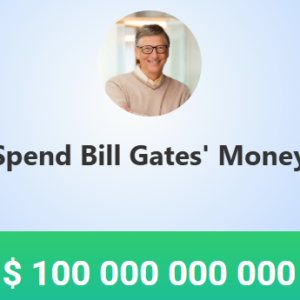
Spend Bill Gates’ Money is a financial simulation created by Neal Agarwal that gives the player a virtual balance of $100 billion. The objective is to spend the entire amount by purchasing products from a fixed catalog. All transactions use fictional money, and the game does not reproduce Bill Gates’ actual possessions or personal spending decisions. Its purpose is to demonstrate the scale of a billionaire’s fortune through familiar prices.
Shopping Begins with Everyday Items
The catalog is arranged from inexpensive products to major assets. Early options include a Big Mac, flip-flops, books, movie tickets, video games, and smartphones. Further down the list are cars, houses, aircraft, businesses, and sports teams. Pressing Buy adds one unit of an item and immediately subtracts its price from the remaining balance. The Sell button removes a purchased unit and returns the corresponding amount.
From Two Dollars to Billions
Spend Bill Gates’ Money has no plot, characters, missions, or numbered levels. Progress is visible through the decreasing money counter and the quantities shown beside purchased goods. Cheap products have almost no effect on the starting fortune, so expensive options become necessary when the goal is to reach zero. The range of prices allows players to compare ordinary expenses with purchases worth millions or billions.
Available purchases include examples such as:
- a Big Mac for $2;
- a Tesla for $75,000;
- a mansion for $45 million;
- a Boeing 747 for $148 million;
- an NBA team for $2.12 billion.
Managing the Final Balance
The game is controlled by selecting Buy or Sell beside each item. Players can purchase the same product repeatedly, so it is possible to spend billions on a single category. Buying NBA teams, cruise ships, skyscrapers, or paintings reduces the balance quickly. Smaller purchases become useful near the end because their prices make it easier to adjust the remaining total. Selling an item allows mistakes to be corrected without restarting the session.
There are no opponents, time limits, upgrades, or failure conditions in the original version. The player decides how to distribute the money and can follow a practical, unusual, or repetitive spending plan. Reaching exactly zero requires combining products with different prices rather than selecting only the most expensive option. Spend Bill Gates’ Money ends as a personal calculation challenge and a comparison of purchasing power, showing how many ordinary and high-value items can fit inside a $100 billion budget.
