

Similiar games

















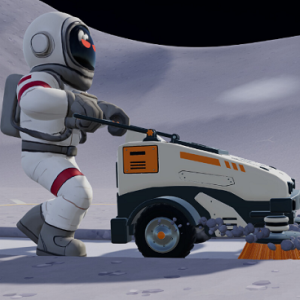
Moon Sweepers – Build an Efficient Dust-Collecting Operation
The most interesting challenge in Moon Sweepers is not how to move a brush across the ground. It is how to build an operation that can handle a truly unreasonable amount of lunar dust. At the beginning, your resources are limited and every delivery demands personal effort. Later, better equipment and automated systems let you work on a much larger scale. The game gradually changes from a small cleaning assignment into an exercise in logistics, resource handling, and efficient investment. Players who enjoy optimizing systems will find plenty to think about beneath the absurd premise.
Understand the Production Loop
Your operation begins with a straightforward chain: remove dust, collect it, transport it, and convert it into income. Each stage depends on the others. Cleaning faster has limited value if your storage fills immediately, while additional carrying capacity is wasted if you cannot gather material quickly enough. Deliveries also take time, especially when you move farther from the depot. A productive setup balances all four stages rather than maximizing only one. This is the first important principle to learn before investing heavily in upgrades.
Identify the Bottleneck
A bottleneck is the part of the operation that prevents everything else from running at full capacity. In Moon Sweepers, it may be the speed of your cleaning tool, the size of your storage, or the distance to your delivery point. Pay attention to where you spend the most time. If you are constantly unloading, increase capacity. If you carry very little dust after a long cleaning session, improve collection efficiency. If transportation dominates your routine, rethink the route between the work area and the depot. Solving the correct problem can produce a larger improvement than purchasing several unrelated upgrades.
Plan for Expansion
An efficient early setup may become awkward once you begin cleaning distant sections of the Moon. The further your operation spreads, the more important its layout becomes. Think about the relationship between collection zones, transportation routes, and processing equipment. Avoid creating a system that requires every load to pass through an inconvenient location. As you gain access to additional infrastructure, design around the way materials actually move. Good planning reduces unnecessary travel and makes it easier to expand without rebuilding everything from scratch.
Automation Is About Flow
Conveyor belts and processing equipment introduce a new layer of decision-making. Automated systems are valuable only when materials can enter, move through, and leave them reliably. An impressive machine does little if the supply route is incomplete or another component cannot keep up. Treat the operation as a connected chain and look for places where dust accumulates or movement slows. Sometimes the best improvement is not a new machine but a better connection between the equipment you already own. That makes automation rewarding because careful organization produces visible practical results.
Invest in Capacity at the Right Time
It is tempting to purchase the most powerful cleaning tool as soon as you can afford it. However, a faster machine can expose weaknesses elsewhere. If it generates dust more quickly than your storage and transportation can handle, you may spend much of your time waiting or unloading. A balanced approach is to upgrade the limiting stage, test the result, and then reassess. This gradual method prevents expensive equipment from sitting idle and helps you understand which investments genuinely improve productivity.
Multiplayer as a Division of Labor
Cooperative sessions support up to sixteen players, making specialization possible. A team can assign people to cleaning, hauling, and infrastructure management instead of having everyone compete for the same patch of ground. Clear responsibilities reduce wasted movement and allow the operation to grow faster. Communication is particularly useful when several players are expanding into new areas at once. Without coordination, the crew may produce more material than the delivery system can process. With a plan, the same group can become a remarkably efficient lunar workforce.
From Manual Labor to Industrial Scale
The real achievement in Moon Sweepers is building a system that makes a once-impossible task feel manageable. You begin with a toothbrush and end up thinking about machines, routes, throughput, and resource value. The setting remains absurd, but the decisions become increasingly meaningful. If you enjoy games where progress comes from improving a process rather than defeating an enemy, the Moon provides a wonderfully oversized factory floor.
