

Similiar games












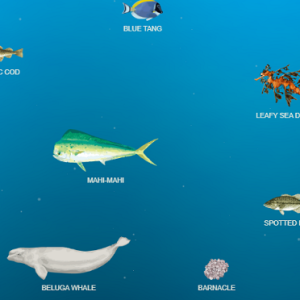
The Deep Sea is an interactive ocean-depth visualization created by Neal Agarwal. The experience begins at the water’s surface and continues downward for more than ten thousand meters. Instead of controlling a diver or submarine, the player scrolls through a vertical section of the ocean. A depth counter records the descent while animals, plants, shipwrecks, geological locations, and historical events appear at their corresponding depths.
Life Changes as Sunlight Disappears
Near the surface, users encounter dolphins, sea turtles, sharks, crabs, coral, and other familiar species. Scrolling deeper reveals animals adapted to cold water, high pressure, limited food, and darkness. The background gradually changes as sunlight becomes weaker. Information boxes explain behaviors such as bioluminescence, deep diving, camouflage, slow metabolism, and feeding methods used by organisms that live far below the surface.
Ocean Zones Replace Traditional Levels
The Deep Sea has no story campaign, objectives, enemies, or numbered stages. Its sections are based on real ocean zones, including the Twilight Zone, Midnight Zone, Abyssal Zone, and Hadal Zone. Each area contains species associated with its depth range. The descent also passes landmarks such as the average ocean depth, the wreck of the Titanic, deep-sea trenches, and locations reached during scientific expeditions.
During the journey, users can discover:
- the maximum diving depths of whales, seals, and penguins;
- anglerfish, viperfish, giant isopods, and Dumbo octopuses;
- corals, worms, snails, and crabs living near hydrothermal vents;
- the Titanic and USS Johnston shipwrecks;
- the Trieste expedition to the Challenger Deep.
Reaching the Bottom by Scrolling
The only required control is vertical scrolling. Users can move slowly to read every fact or descend quickly to compare the scale of different depths. Illustrations identify each organism, and short text sections explain why particular records or discoveries are important. There are no items to collect, puzzles to solve, or scores to improve. Progress is measured only by the current depth and the distance remaining to the ocean floor.
The final section covers the Hadal Zone and the descent of Jacques Piccard and Don Walsh aboard the Trieste in 1960. Their journey ended at the Challenger Deep, the deepest known point in the ocean. Reaching this area completes the visualization, although users can scroll upward to revisit earlier species and records. The Deep Sea functions as an educational exploration rather than a conventional game, using scale and movement to show how ocean conditions and forms of life change with depth.
