

Similiar games


















Masked Singer Simulator operates as a procedural simulation environment designed to model the structure of masked singing competitions. The gameplay framework abstracts the competition format into configurable systems driven by elimination logic and rule-defined progression. Instead of presenting live performances or audio mechanics, the simulator focuses on contestant management and outcome generation. Each session functions as a structured sequence where advancement is determined by predefined rules rather than player-controlled actions.
Contestant Setup And Structural Design
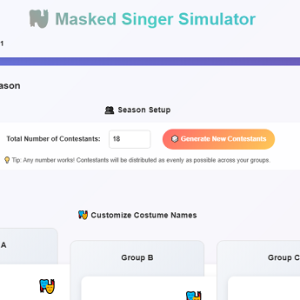
The simulation cycle begins with configuring participants. Users define contestant pools by entering names or generating randomized characters. Structural variables such as grouping, matchups, or bracket arrangements influence how rounds unfold. The setup phase functions as a core mechanic, as changes to participant distribution directly affect elimination flow and progression dynamics. This structure transforms configuration into a primary interaction component.
Voting Systems And Elimination Mechanics
Voting logic drives progression within Masked Singer Simulator. Each round processes eliminations according to selected rules, determining which masked contestants advance. Outcome variability emerges from rule dependencies rather than dynamic gameplay input. Automated systems ensure consistent processing of votes and eliminations, producing predictable yet adjustable results. The simulator prioritizes rule interaction over mechanical complexity.
Core gameplay systems typically include:
- Contestant pool configuration
- Randomized character generation
- Voting rule selection
- Automated elimination cycles
- Round-based progression tracking
- Reveal and outcome reporting
These systems define simulation behavior.
Outcome Generation And Analytical Use
Masked Singer Simulator functions primarily as an analytical modeling tool. Users observe how different rule configurations influence elimination patterns and competition flow. The absence of performance mechanics shifts emphasis toward interpreting system behavior and exploring hypothetical scenarios. Repeated simulations allow comparison of structural variations, enabling experimentation with contestant arrangements and voting models.
Masked Singer Simulator emphasizes procedural logic and rule-based variability within a competition-inspired framework. Gameplay sessions revolve around configuring variables, executing elimination rounds, and analyzing outputs. Over time, engagement becomes centered on optimizing simulation structures, evaluating outcome trends, and testing alternative rule combinations. The design prioritizes predictability, replayability, and controlled experimentation rather than traditional gameplay progression.
